Home › Guides › Humidity, Hard Water and Choosing Materials That Last Here
Humidity, Hard Water and Choosing Materials That Last Here
The same kitchen specified for Phoenix and for Houston should not be the same kitchen. Months of high humidity, hard water and storm exposure change which cabinet box, which exhaust fan, which grout and which stone are still doing their job ten years from now.
- Licensed & Insured
- 20+ years remodeling
- Houston metro
- Free site visit
The short answer
Gulf Coast humidity and hard water shorten the life of the wrong materials. Specify plywood cabinet boxes below the counter, a properly sized bath fan ducted in rigid pipe to the outside, epoxy or well-sealed grout, and honed stone or porcelain rather than polished marble, which both mineral scale and acidic cleaners ruin.
What months of wet air actually do inside a house
Everything here comes back to one fact: the air in this region holds a great deal of water for a large part of the year, and the number on your thermostat tells you nothing about it. What matters is dew point. Warm, wet air gives up its moisture the instant it touches something cool — a supply line inside a sink cabinet, the back of an exterior wall, an uninsulated duct in the attic.
Inside a finished house that shows up as:
- Swollen, crumbling cabinet bottoms under a sink that had a slow drip nobody caught for a month
- Doors and drawer fronts that line up in January and stop lining up in August
- A musty smell in a closet on an exterior wall, or in a guest bath nobody runs
- Mildew on caulk and grout in a shower that gets used but not ventilated
- Cupping in wood flooring that was laid too tight, or laid before the house was conditioned
There is an HVAC angle worth knowing before you remodel. An oversized system cools the house fast, shuts off, and never runs long enough to pull water out of the air. The house hits temperature and still feels clammy. If you are opening walls anyway, that is the moment to have the system assessed — removing a wall or adding square footage changes the load, and ignoring it leaves you with a beautiful room that feels damp.
Specification here is not about luxury. It is about what survives this.
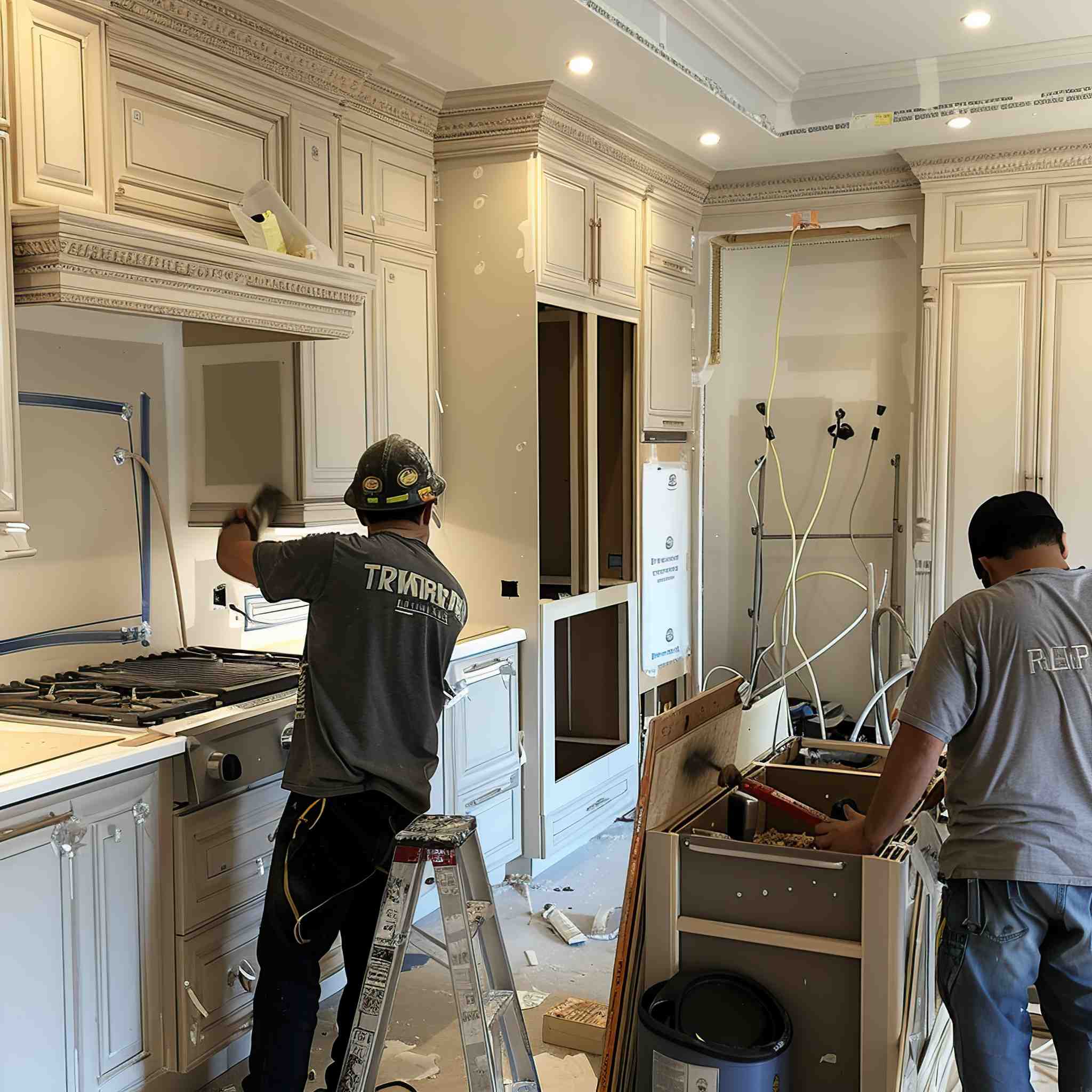
Cabinet boxes: plywood, particleboard, and where each one is honest
The biggest durability decision in a Houston kitchen or bathroom is what the cabinet boxes are made of, and it is almost invisible in a showroom.
Particleboard, sometimes sold as furniture board, is wood chips and glue. It is flat, dimensionally stable, inexpensive, and perfectly adequate in dry conditions. Its failure mode is water. Once the bottom of a sink base gets wet it swells, loses its grip on the fasteners and never comes back. Plywood gets wet too, but it dries, still holds screws afterward, and can usually be saved.
What we would specify here:
- Plywood boxes throughout wherever the budget allows, and without argument for the sink base, the run beside the dishwasher, and every bathroom vanity
- A finished, sealed cabinet floor under the sink, or a fitted drip liner, so the first leak is a wet towel instead of a rebuild
- Solid wood or plywood drawer boxes with dovetail or dowelled joints rather than stapled particleboard
- Solid wood or good MDF for painted doors and face frames — MDF holds paint beautifully and stays flat, but it hates standing water, so keep it off the floor of a wet area
Upper cabinets away from water are the honest place to save. A particleboard upper box in a pantry will outlast the kitchen around it. Put the difference below the counter, where the water is. When you shop, ask what the boxes are made of; showrooms rarely volunteer it.

Exhaust: sizing it, ducting it, and where the air actually goes
Ventilation is where corners get cut quietly, and the damage shows up years later behind the tile.
A bath fan has to be sized to the room and then actually be able to move that air. The common rule of thumb is roughly one CFM per square foot of floor for an ordinary bathroom, with more for a large room, a separate enclosed toilet, or a steam shower. But that rating is measured on a test bench. A fan pushing through a long run of crushed flexible duct with two sags in it delivers a fraction of its label.
- Duct it in smooth rigid pipe, as short and straight as the framing allows
- Terminate outside, through the roof or a wall cap with a working damper. Never into the attic, and never into a soffit that dumps it straight back under the eave
- Insulate the duct where it runs through the attic. Warm wet air inside a cold pipe condenses, and that water runs back down and drips through the fan into the room
- Put it on a timer or a humidity sensor, so the fan keeps running after the shower — which is when it does the real work
Kitchens are the same argument at a larger scale. A recirculating hood filters grease and returns the heat and moisture to the room. A ducted hood puts it outside. Above a certain airflow, code requires make-up air so the hood is not depressurizing the house; the threshold depends on the code your jurisdiction has adopted, so we confirm it for your address rather than guess.
Hard water on glass and stone: two different problems
Houston water is hard, and hardness attacks a bathroom in two completely different ways. People conflate them, then buy the wrong fix and make it worse.
Scale is mineral left behind when water evaporates. On frameless shower glass it starts as spotting and becomes a permanent cloudy haze, because the minerals work into the microscopic pores of the glass surface. Once it is in, no cleaner brings it back — that glass gets professionally polished or replaced.
Etching is acid dissolving stone. Marble, limestone and travertine are calcium carbonate, so anything acidic dulls them on contact: lemon, vinegar, wine, many bathroom cleaners, and most of the descalers people reach for to fight scale. That is the trap. You buy an acidic hard-water cleaner and it eats the countertop you were cleaning.
What actually holds up:
- A factory-applied protective coating on new shower glass, plus a squeegee that lives in the shower. The habit matters more than the product.
- Honed or leathered stone instead of polished, if you want natural stone — both scale and etching are far less visible on a matte surface.
- Quartz, or a good porcelain slab, where you want the marble look without the chemistry. Porcelain is unaffected by acid.
- Whole-house softening if hardness is bothering you throughout the house, which also protects the water heater and fixture cartridges. Test the water before you buy equipment.
Waterproofing and sealant: the parts you never see again
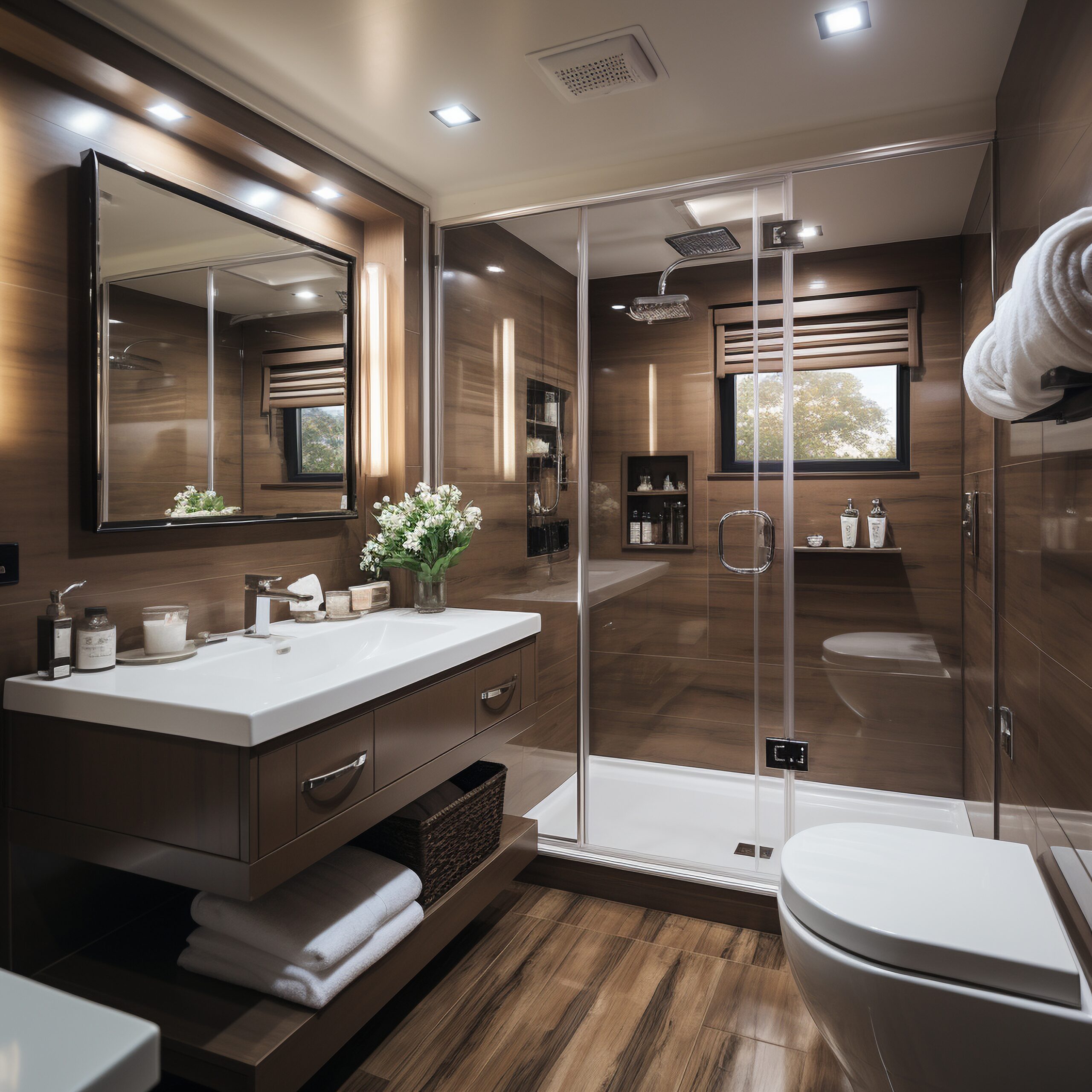
The parts of a bathroom that decide whether it lasts are all buried before the tile goes on.
Grout is not waterproof and was never meant to be. Water gets through a tiled wall; the assembly behind it is what keeps that water out of the framing. That means a bonded liquid or sheet membrane over the substrate, or a foam board system with sealed seams — installed as one continuous system using the manufacturer’s own corners, bands and sealant, rather than a mix of brands that were never tested together.
Details that matter more than the tile you picked:
- Every change of plane gets flexible sealant, not grout. Wall to wall, wall to floor, wall to tub, around the curb. Those are the joints that move.
- Niches get sloped so water drains out, and get waterproofed as part of the wall rather than as an afterthought cut into it.
- The pan gets pre-sloped to the drain underneath the waterproofing, so water that gets into the assembly has a way to leave.
- Curbless showers need a real decision about where the floor is going. Over a slab that means recessing the concrete or raising the rest of the room — which is why the slab conversation and the shower conversation are the same conversation.
- Cementitious grout needs sealing and resealing. Epoxy grout needs neither and shrugs off hard water, but it is less forgiving to install and costs more in labor.
None of this photographs well. It is the entire difference between a shower that is fine in ten years and one that is not.
Floors and finishes over a Houston slab
Flooring here has to tolerate two things at once: vapor moving up through the concrete, and the seasonal humidity swing in the room above it.
- Solid hardwood laid directly over a slab is a fight you usually lose. Concrete gives off vapor for years and never fully stops, and solid boards respond by cupping.
- Engineered wood is the sane way to get real wood downstairs — its layered construction moves far less across the width of a board. It still needs the slab moisture-tested first, a vapor retarder, an expansion gap at every wall, and time acclimating inside the conditioned house. Skipping acclimation is the most common reason a wood floor fails here.
- Porcelain tile does not care about any of it. It is the default ground-floor answer in this climate, provided it gets the movement-joint detailing a Houston slab requires.
- Luxury vinyl plank handles water well and is quieter underfoot, but cheaper products telegraph every ridge in the slab and can gap in summer if they were installed tight to the walls. Flatness prep and expansion gaps still apply.
Two finish notes. In a bathroom, use a washable, mildew-resistant sheen rather than a flat paint that holds moisture and burnishes the first time you wipe it. And understand the fixture finish you chose: PVD finishes are hard and shrug off cleaning, while a living finish is designed to change with use — which some people love and some people call a defect six months in.
Specifying for storm and flood exposure
Flood exposure is a material decision, not only an insurance one. Parts of this metro flood from bayous, parts flood because street drainage backs up in a slow-moving storm, and some houses have taken water more than once. If yours has, or if it sits low, specify the ground floor so it can be dried out and put back rather than gutted.
Choices that pay for themselves:
- Tile or a good waterproof plank on the ground floor instead of carpet or solid wood
- Removable base and a paint-grade trim detail, so pulling the lowest few inches of wall is a small job
- Closed-cell or mineral-based insulation in the bottom of exterior walls rather than paper-faced batt, which wicks and holds water
- Cabinet toe kicks in a material that survives contact with water, with adjustable legs instead of an integral particleboard base where it makes sense
- Outlets and equipment placed with a wet floor in mind while the wall is already open
Check the flood mapping for your address before you plan. FEMA maps are public and Harris County publishes its own flooding information. Also ask your local floodplain administrator whether a substantial-improvement threshold applies to your project, because a large remodel on a mapped property can trigger requirements that change the entire scope. That is a question for before design, not after.
MS Home Remodeling works across the Houston metro — Katy, Cypress, Sugar Land, Missouri City, Pearland, Spring, Tomball, The Woodlands, League City and out to Fulshear, Richmond and Rosenberg. Call (281) 235-6971.
Common questions
Are plywood cabinet boxes worth paying for here?
Below the counter, yes. Particleboard is fine until it gets wet, and then it swells, loses its grip on screws and does not recover. Plywood dries out and can usually be saved. Spend it on the sink base, the run beside the dishwasher, and every bathroom vanity. Upper cabinets away from water are the honest place to save. Ask what the boxes are made of, because showrooms rarely volunteer it.
Will a water softener fix my cloudy shower glass?
It will stop new scale from forming, which is worth a lot. It will not reverse a haze already worked into the glass surface — that glass gets professionally polished or replaced. Have your water tested before buying equipment, and know that even with softened water you still want a squeegee habit and a protective coating on new glass to keep it clear.
My bathroom keeps growing mildew even though there is a fan. Why?
Usually the fan is undersized for the room, choked by a long crushed flexible duct, terminating into the attic instead of outdoors, or only running while somebody is standing in the room. The moisture leaves after the shower, not during it. A correctly sized fan in rigid duct, vented outside, on a timer or humidity sensor, fixes most of these rooms.
Can I put hardwood floors on a Houston slab?
Engineered wood, yes — with the slab moisture-tested first, a vapor retarder, an expansion gap at every wall, and time acclimating in the conditioned house. Solid hardwood directly over a slab is a fight you usually lose, because concrete releases vapor for years and solid boards cup in response. If you want the look with none of the risk, porcelain plank tile has gotten very convincing.
Is marble a bad idea in a Houston bathroom?
Not bad, just demanding. Marble is calcium carbonate, so it dulls wherever acid touches it — including most hard-water cleaners people buy to fight scale. If you love it, choose honed rather than polished so wear reads less, seal it, and keep acidic cleaners out of the room. If you want the look without the upkeep, a porcelain slab is unaffected by acid.
Related reading
- Custom, Semi-Custom and Stock Cabinetry
- Choosing Flooring for a Houston Home
- Waterproofing: What Decides Whether a Bathroom Lasts
- Houston Housing Stock, Decade by Decade
Services this applies to
Request an estimate
Tell us the room and the goal. We measure on site, look at the slab and the existing rough-in, then quote.
Start with a measured site visit
We look at the slab, the existing rough-in and the room, then give you a scope you can compare against any other bid.
MS Home Remodeling · 1530 W Sam Houston Pkwy N, Houston, TX 77043 · (281) 235-6971