Home › Services › Bathroom Remodeling
Bathroom Remodeling in the Houston Metro
A 1968 bathroom in Oak Forest and a 2006 bathroom in Cinco Ranch can be the same eight-by-ten box on paper. They are not the same job. The older room hides cast iron drains, galvanised supply, sometimes aluminium branch wiring,…
- Licensed & Insured
- 20+ years remodeling
- 17 cities served
- 102 ZIP codes covered

In short
On the older house the work starts behind the finishes. We open the wet wall, camera the drain where cast iron is suspected, and check the branch supply for the rust scaling that shows up as a weak shower head. Galvanised runs get replaced back to a sound connection in PEX or copper. Old lead bends…
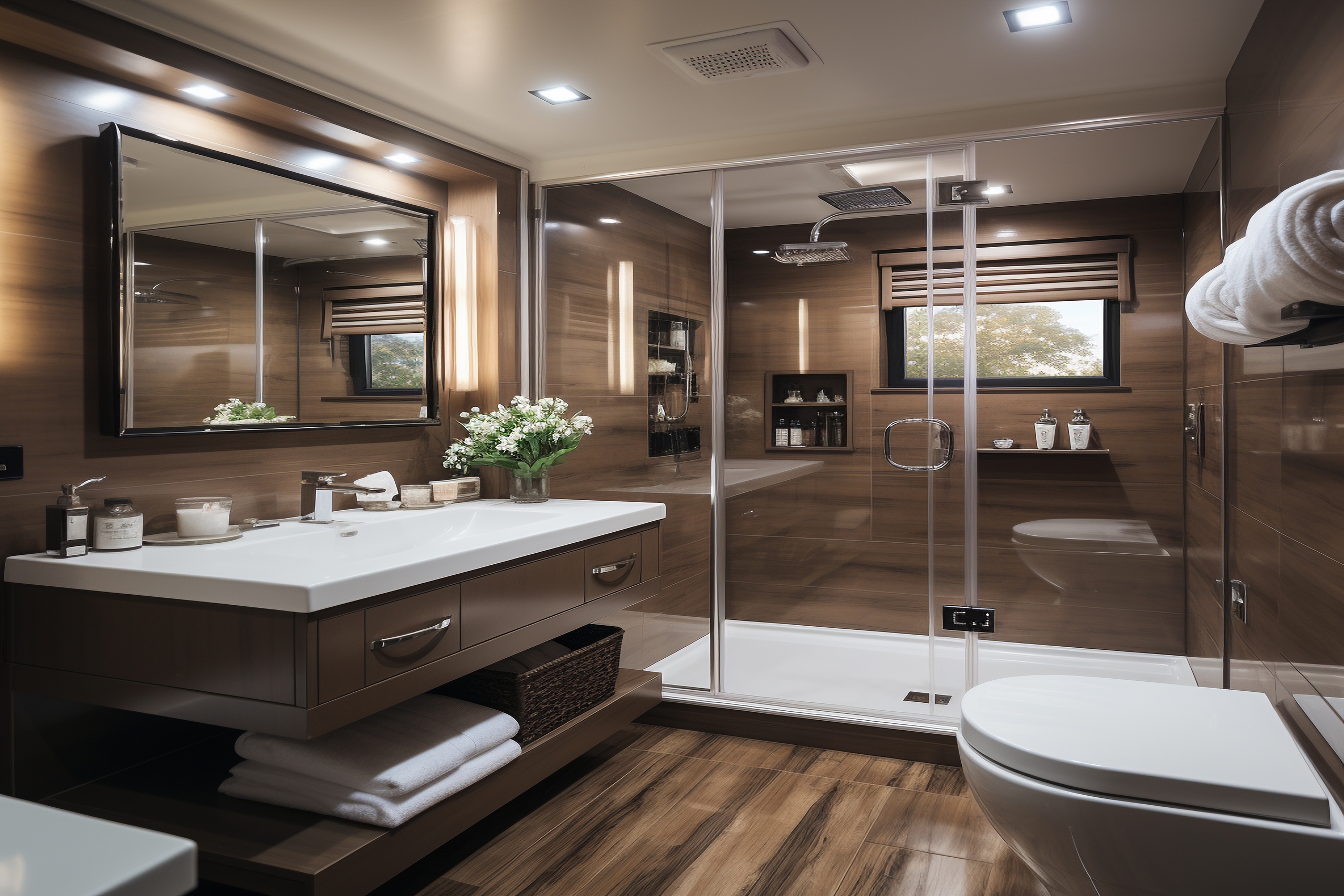
What the work involves
On the older house the work starts behind the finishes. We open the wet wall, camera the drain where cast iron is suspected, and check the branch supply for the rust scaling that shows up as a weak shower head. Galvanised runs get replaced back to a sound connection in PEX or copper. Old lead bends and poorly vented trap arms get rebuilt with current fittings. Where aluminium branch wiring is present, devices are remediated with connections rated for it rather than reused. Then the room goes back together: framing corrections, blocking for grab bars and glass hinges, backer board, waterproofing, tile, trim, fixtures. On the newer suburban house the concealed systems are usually sound, so the conversation moves quickly to layout. Can the drain move. Can the soffit come out. Can the shower go curbless. On post-tension slab that question is answered by scanning, not optimism. The rebuild sequence is identical; discovery is shorter and design is longer, which is why two rooms of the same size run very differently.
What gets specified, and why
In older houses the substrate decides the material list. Plaster over wood lath, or 1950s mud-set tile on wire, does not take modern thinset directly, so the wet wall usually gets stripped to studs and rebuilt with cement backer or a foam board system, then a bonded waterproofing membrane. Newer houses often have paper-faced board behind the tub surround, which is not a wet-area substrate no matter how clean it looks. Cabinet boxes get specified in plywood everywhere in this metro; particleboard swells at the toe kick from mopping and humidity alone, before any leak. Porcelain outperforms natural stone on hard water, because scale that etches marble only films porcelain. High-performance cement grout is the usual pick, with silicone rather than grout at every change of plane so movement has somewhere to go. Fixture finishes matter more here than in dry climates: chrome and PVD-coated finishes shed Houston scale better than plated matte finishes, which show every water spot and wear thin at the handle.
Why the Gulf Coast changes this job
Much of the older stock inside the Loop sits on pier and beam, which is an advantage here: a plumber can work from below, so relocating a toilet or shower drain is careful joist work rather than jackhammering concrete. Slab houses of the same age give that up. Slab houses west of the Beltway built after the mid-eighties are often post-tension, where coring without locating tendons is not a chance worth taking. Expansive clay moves under both. That seasonal movement is why a tile floor fine for three summers cracks along one line in a dry autumn, and why crack isolation membrane and soft movement joints belong in the floor rather than on an upgrade list. Humidity is constant on both sides of town. An exhaust fan terminating in the attic instead of outside will wet a roof deck slowly in this climate, and we find it in houses of every vintage.
Where these jobs go wrong
The common failure in older houses is remodelling around the old drain instead of inspecting it. Cast iron with a belly or a scaled interior will keep backing up under a brand-new floor, and the fix then means opening what was just finished. Camera it while the wall is open. The second is treating aluminium branch wiring as a wiring colour rather than a connection problem, and putting standard devices back in. In newer houses the recurring mistake is promising a curbless shower or a moved toilet on a post-tension slab before anyone scans it. The third, shared by both, is a fan that vents into the attic or through a long sagging flex run where condensate collects and drips back. Duct it short, insulated, sloped, to a proper exterior or roof termination with a damper. And in both, tile is set without crack isolation over a slab that will move seasonally, so the crack telegraphs through at the first dry spell.
What moves the price
Concealed condition is the biggest variable in older homes: replacing galvanised supply, correcting venting, remediating aluminium branch wiring, and repairing framing or subfloor found wet at demolition. None of that shows in the finished room, and all of it moves the number. In newer homes the drivers are usually elective: moving the drain, removing a soffit, curbless entry, large-format tile that demands a flatter substrate, and frameless glass sized to the opening. Both share tile pattern complexity, niche and bench work, vanity class, countertop material, and whether the electrical panel has capacity for added circuits. Jurisdiction matters too, since work inside Houston, in unincorporated Harris County, and in Fort Bend is permitted differently. Ask for the concealed-condition items to be priced as a named allowance rather than buried, so the estimate stays honest when the wall opens.
How a project runs
We walk the room first, look at the drain, the supply, the panel, and the attic above the fan before quoting. Older homes get a camera inspection where cast iron is likely. Selections are made before demolition so tile, vanity and glass hardware are on hand when the trades need them. Demolition, then rough plumbing and electrical, then any inspection the jurisdiction requires, then backer, waterproofing, and a water test. Tile, grout, cure. Glass is templated after tile so it fits the wall that actually exists. Fixtures, trim, paint, final clean. To set up a walkthrough, call (281) 235-6971.
Common questions
My house is from the 1970s. Do I have to replace all the plumbing?
Not automatically. What matters is condition, not age. If the supply is galvanised and showing reduced flow, replacing the branch runs while the wall is open is far cheaper than doing it later. Cast iron drains vary; some are sound, some have scale or a belly. A camera inspection during demolition answers it before you commit to a floor.
Why can’t my builder-grade shower drain move a few feet?
On a post-tension slab the concrete is held in compression by steel tendons. Cutting one is a serious repair. Any drain relocation starts with locating the tendons, and sometimes the scan says no. The alternatives are a linear drain positioned where the existing line allows, or building the floor up so the new drain line runs above the slab.
Is a pier-and-beam bathroom harder to remodel?
Usually easier for plumbing and harder for floors. Working from the crawlspace makes drain relocation practical without concrete work. The trade-off is deflection: a springy joist bay will crack tile, so the framing gets checked and stiffened, and an uncoupling or crack isolation membrane goes down before any tile is set.
The bathroom smells musty even after remodelling. Why?
Almost always ventilation. A fan that is undersized for the room, ducted through a long sagging flex run, or terminating inside the attic will not clear the moisture load a Houston shower produces. Check that the duct is short, insulated, sloped toward the outside, has a working damper, and actually exits the building.
Bathroom Remodeling by location
We cover 102 ZIP codes across the Houston metro. Pick the area closest to you:
- Bellaire 77401
- Brookshire 77423
- Cypress 77429
- Cypress 77433
- Fresno 77545
- Fulshear 77441
- Houston 77002
- Houston 77003
- Houston 77004
- Houston 77005
- Houston 77006
- Houston 77007
- Houston 77008
- Houston 77009
- Houston 77010
- Houston 77011
- Houston 77014
- Houston 77016
- Houston 77018
- Houston 77019
- Houston 77020
- Houston 77021
- Houston 77022
- Houston 77023
- Houston 77024
- Houston 77025
- Houston 77026
- Houston 77027
- Houston 77028
- Houston 77030
- Houston 77031
- Houston 77033
- Houston 77035
- Houston 77036
- Houston 77037
- Houston 77038
- Houston 77039
- Houston 77040
- Houston 77041
- Houston 77042
- Houston 77043
- Houston 77045
- Houston 77046
- Houston 77047
- Houston 77048
- Houston 77051
- Houston 77053
- Houston 77054
- Houston 77055
- Houston 77056
- Houston 77057
- Houston 77060
- Houston 77063
- Houston 77064
- Houston 77065
- Houston 77066
- Houston 77067
- Houston 77068
- Houston 77069
- Houston 77070
- Houston 77071
- Houston 77072
- Houston 77074
- Houston 77076
- Houston 77077
- Houston 77079
- Houston 77080
- Houston 77081
- Houston 77082
- Houston 77083
- Houston 77084
- Houston 77085
- Houston 77086
- Houston 77087
- Houston 77088
- Houston 77090
- Houston 77091
- Houston 77092
- Houston 77093
- Houston 77094
- Houston 77095
- Houston 77096
- Houston 77098
- Houston 77099
- Houston 77204
- Katy 77449
- Katy 77450
- Katy 77493
- Katy 77494
- Missouri City 77459
- Missouri City 77489
- Orchard 77464
- Richmond 77406
- Richmond 77469
- Rosenberg 77471
- Simonton 77476
- Spring 77379
- Stafford 77477
- Sugar Land 77478
- Sugar Land 77479
- Thompsons 77481
- Tomball 77377
Planning bathroom remodeling?
We measure, look at the slab and the existing rough-in, and give you a scope you can actually compare against another bid.
MS Home Remodeling · 1530 W Sam Houston Pkwy N, Houston, TX 77043 · (281) 235-6971